
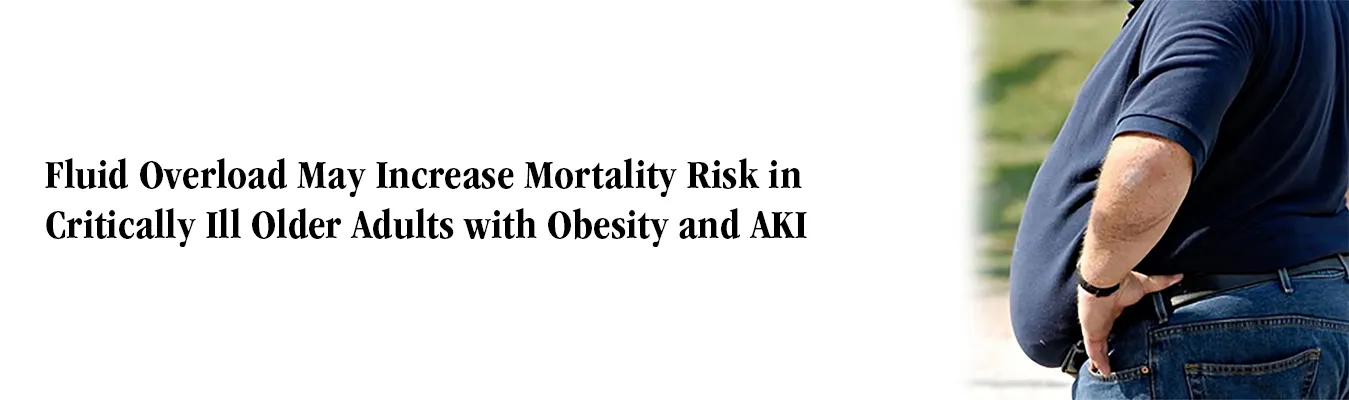

Fluid Overload May Increase Mortality Risk in Critically Ill Older Adults with Obesity and AKI
Dr Sahil Kharbanda, Consultant Nephrologist and Transplant Physician, Karnal; and Dr Sanjay Kalra
Fluid overload was associated with higher 90-day mortality in elderly critically ill patients with obesity and acute kidney injury.
Acute kidney injury (AKI) is a serious condition in critically ill patients. It involves a sudden decline in kidney function and is linked with significant morbidity and mortality.
It affects around 13.3 million people worldwide each year, with mortality among critically ill patients estimated at 20%–50%. Fluid management in critically ill patients with obesity can also be challenging, as standard weight-based formulas may increase the risk of fluid overload.
A retrospective study published in Science Progress looked at the link between hydration status and mortality in older critically ill patients with obesity and AKI. AKI was defined using Kidney Disease: Improving Global Outcomes (KDIGO) criteria, while fluid overload was defined as a body weight-adjusted fluid balance above 10%.
The study included 539 patients, and 244 developed fluid overload. Over the 90-day follow-up, 209 patients died. Deaths were more common among patients who developed fluid overload than among those who did not.
Kaplan–Meier analysis also showed higher mortality among patients with fluid overload. Multivariate Cox regression identified fluid overload and Sequential Organ Failure Assessment (SOFA) score as independent predictors of increased mortality.
Overall, fluid overload was linked to a higher risk of death within 90 days in older critically ill patients with obesity and AKI. These findings highlight the importance of careful fluid management in this group. Avoiding excess fluid and closely monitoring fluid balance and the patient’s response to treatment may help improve outcomes in the ICU.
(Reference: Yang J, Yang J. Association between hydration status and mortality in elderly obese critically ill patients with acute kidney injury: A retrospective cohort study. Science Progress. 2026 Jan;109(1):00368504251404080..)
Recent FAQs



Related FAQs







Medtalks is India's fastest growing Healthcare Learning and Patient Education Platform designed and developed to help doctors and other medical professionals to cater educational and training needs and to discover, discuss and learn the latest and best practices across 100+ medical specialties. Also find India Healthcare Latest Health News & Updates on the India Healthcare at Medtalks







Please login to comment on this article