
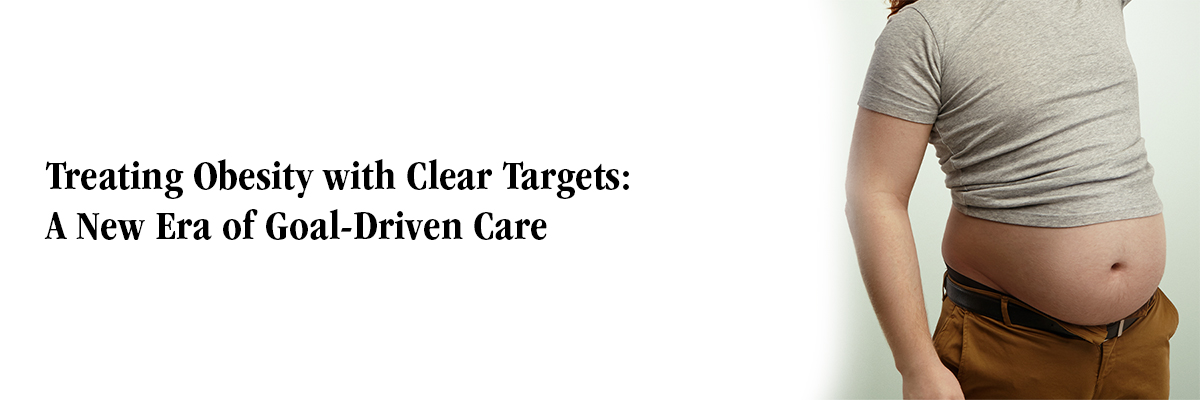

Treating Obesity with Clear Targets: A New Era of Goal-Driven Care
Dr. Saurabh Arora, Consultant Endocrinologist, Fortis Hospital, Mal Road, Ludhiana
In obesity management, reaching clear targets—especially a waist-to-height ratio below 0.53—may better define meaningful cardiometabolic improvement than percent weight loss alone.
Obesity medicine is advancing rapidly, yet clarity around treatment goals has lagged behind therapeutic progress. A new post hoc analysis of the SURMOUNT-5 trial highlights how defined “treat-to-target” thresholds may bring needed structure to obesity management.
Investigators applied the proposed benchmarks, waist-to-height ratio (WHtR) < 0.53 and body mass index (BMI) < 27 kg/m², to adults treated with tirzepatide or semaglutide for 72 weeks. Between 23% and 34% of participants receiving tirzepatide and 14% to 21% receiving semaglutide achieved these targets, along with greater reductions in weight and waist circumference than the overall study averages.
Reaching a WHtR below 0.53 carried clinical significance. Nearly three-quarters of those who met this threshold achieved low disease activity to remission, defined as attaining at least four of five cardiometabolic goals, including normoglycemia, blood pressure, lipids, and inflammatory markers. By contrast, achieving a BMI below 27 kg/m² was not clearly associated with improvements in physical quality-of-life scores.
These findings suggest that absolute adiposity measures—particularly WHtR—may better define meaningful success than percent weight loss alone. As obesity care evolves, adopting structured targets could strengthen shared decision-making and align treatment with tangible improvements in long-term health.
(Source: Le Roux CW, Busetto L, Aronne L, Horn DB, Dimitriadis GK, Falcon B, Garcia‐Perez LE, Valderas EG, Gibble TH, Senyucel C, Dunn JP. A treat‐to‐target approach for obesity management: A post hoc analysis of the SURMOUNT‐5 trial. Diabetes, Obesity and Metabolism. 2026 Feb 3. )
Recent FAQs



Related FAQs







Medtalks is India's fastest growing Healthcare Learning and Patient Education Platform designed and developed to help doctors and other medical professionals to cater educational and training needs and to discover, discuss and learn the latest and best practices across 100+ medical specialties. Also find India Healthcare Latest Health News & Updates on the India Healthcare at Medtalks







Please login to comment on this article