
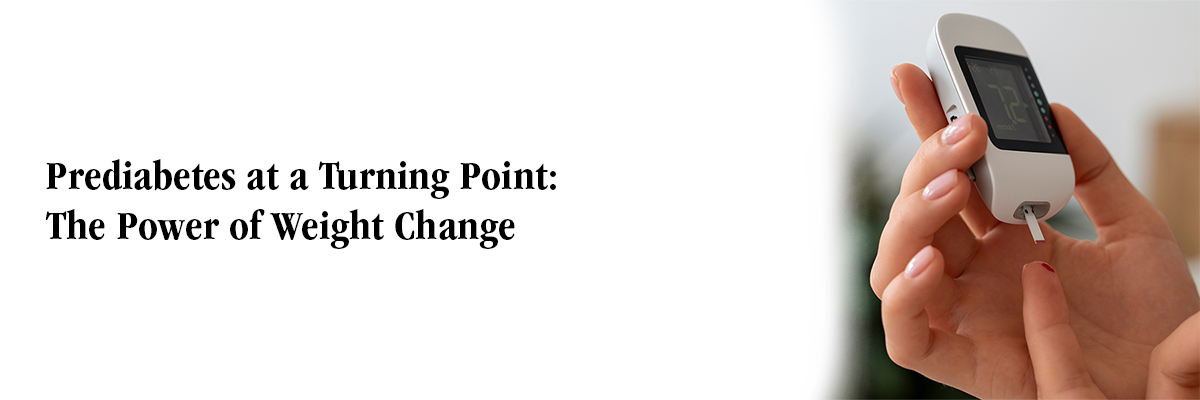

Prediabetes at a Turning Point: The Power of Weight Change
Dr. Phibakordor L Nonglait, MD DM (Endo), Specialist Civil Hospital Shillong, Meghalaya.
Maintaining or achieving a non-obese weight significantly improves the chances of reversing prediabetes and reduces the risk of progression to diabetes.
Prediabetes does not move in a single direction. For many, it can improve. For others, it progresses. What makes the difference? A large national cohort study of 14,452 adults living with persistent prediabetes offers an important clue: body weight over time matters.
Researchers tracked participants’ weight patterns between 2002 and 2008 and identified three distinct groups: those who remained obese (35.7%), those who remained non-obese (47.8%), and those who moved from obese to non-obese (16.5%). Participants were then followed for changes in blood glucose.
The outcomes were telling. After a median follow-up of two years, nearly 52% of individuals returned to normal glucose levels. However, about 32% progressed to diabetes. Those who maintained a non-obese status were more likely to regain normal glycemia and less likely to develop diabetes compared with individuals who remained obese. Encouragingly, even participants who reduced their weight from obese to non-obese saw meaningful improvement in their metabolic trajectory.
The takeaway is both simple and powerful: prediabetes is not an inevitable progression. Sustained weight stability within a healthy range—or even gradual weight reduction—can significantly influence the direction of glycemic health. For clinicians and patients alike, this reinforces the importance of long-term weight management in diabetes prevention.
(Source: Nabila S, Kim JE, Park J, Kim H, Hahn S, Shin A, Kang D, Choi JY. Association of Obesity Status Trajectories with Changes in Prediabetes Glycemic Status. Journal of Cancer Prevention. 2026 Jan 30;31(1):28-37.)
Recent FAQs




Related FAQs








Medtalks is India's fastest growing Healthcare Learning and Patient Education Platform designed and developed to help doctors and other medical professionals to cater educational and training needs and to discover, discuss and learn the latest and best practices across 100+ medical specialties. Also find India Healthcare Latest Health News & Updates on the India Healthcare at Medtalks







Please login to comment on this article