
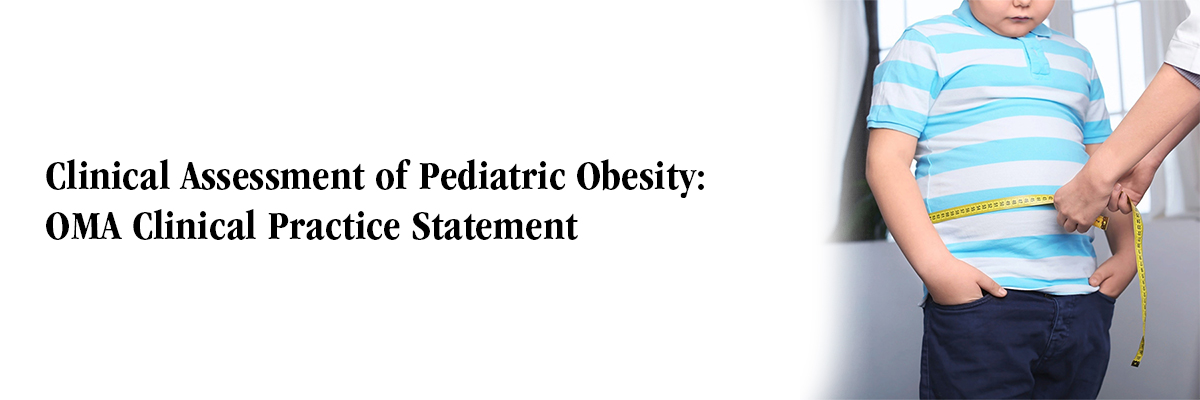

Clinical Assessment of Pediatric Obesity: OMA Clinical Practice Statement
Assessment of pediatric obesity is age dependent and relies on standardized growth charts and BMI-based classifications to accurately identify overweight, obesity, and severe obesity in children and adolescents.
The Obesity Medical Association (OMA) Clinical Practice Statement provides evidence-based guidance for the assessment and initial clinical evaluation of pediatric patients with obesity. The recommendations are intended for children and adolescents with a body mass index (BMI) at or higher than the 95th percentile, particularly those experiencing adverse health consequences related to excess body mass.

For children younger than 2 years, weight status is assessed using weight-for-length percentiles derived from the World Health Organization (WHO) or Centers for Disease Control and Prevention (CDC) growth charts. These charts account for age-related growth patterns and differences in feeding practices.
For children and adolescents aged
2–20 years, body mass index (BMI) percentile is the primary tool for
classifying weight status. Overweight is considered when BMI is between the
85th and 94th percentiles, while obesity isconsidered when BMI is at or above
the 95th percentile.
In individuals with BMI values
exceeding the 95th percentile, obesity severity is further classified using the
percent of the 95th percentile into Class 1, Class 2, and Class 3. Any BMI at
or above 120% of the 95th percentile is considered severe obesity.
BMI standard deviation scores may be
used to adjust for age and sex, but are not recommended for monitoring change
in children and adolescents with severe obesity because of score compression at
higher BMI levels. For these patients, changes in the percent of the 95th
percentile are preferred.
In older adolescents, an absolute
BMI threshold of 35 kg/m² may be used to identify severe obesity, particularly
in boys aged approximately 18 years and girls aged approximately 16 years.
(Source: Cuda SE, Censani M. Assessment, differential diagnosis, and
initial clinical evaluation of the pediatric patient with obesity: an Obesity
Medical Association (OMA) Clinical Practice Statement 2022. Obesity Pillars.
2022 Mar 1;1:100010. )
Recent FAQs





Related FAQs







Medtalks is India's fastest growing Healthcare Learning and Patient Education Platform designed and developed to help doctors and other medical professionals to cater educational and training needs and to discover, discuss and learn the latest and best practices across 100+ medical specialties. Also find India Healthcare Latest Health News & Updates on the India Healthcare at Medtalks







Please login to comment on this article