
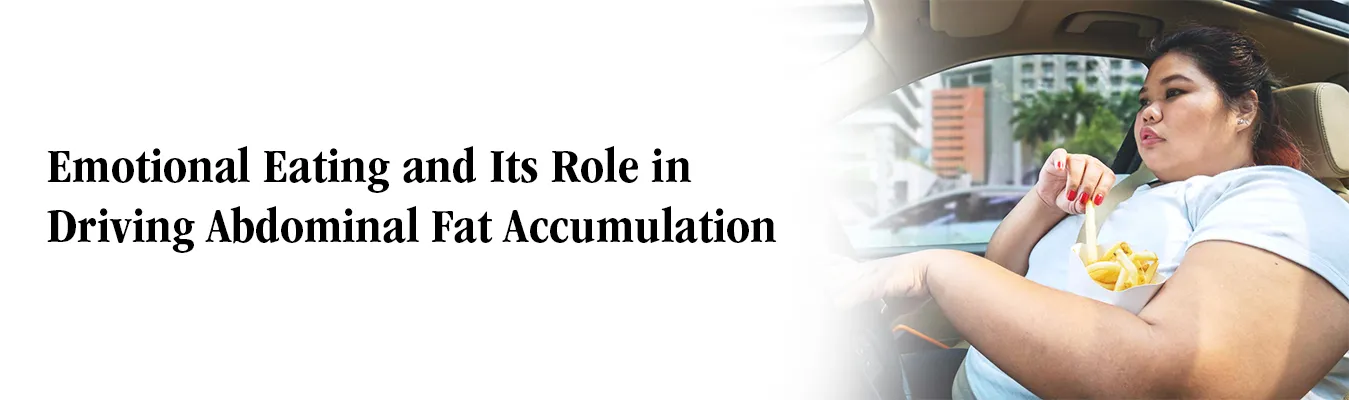

Emotional Eating and Its Role in Driving Abdominal Fat Accumulation
Dr Anu Mathew, Department of Endocrinology, Fortis Hospital, Manesar
Emotional eating is closely linked to abdominal obesity and promotes overconsumption of comfort foods, which may cause increased visceral fat storage.
Abdominal obesity refers to excessive fat accumulation in the abdominal region and is measured using waist circumference, a validated anthropometric marker for cardiometabolic risk assessment. The World Health Organization applies different cutoffs by region for it; in the Middle East and South and East Asia, the cutoffs are ≥90 cm for men and ≥80 cm for women.
Emotional eating can be defined as eating in response to emotions instead of true physical hunger. It is often linked to poor emotional regulation, long-term stress, anxiety, or depression. These emotional states can activate the body's stress response, increasing cortisol levels and encouraging cravings for comfort foods.
Researchers sought to examine the mechanisms underlying the association between emotional eating and abdominal obesity, and to explore emerging interventions for its management.
To do this, researchers conducted a narrative review of studies published between 2015 and 2025 using PubMed and Google Scholar. Search terms covered emotional eating, hedonic hunger, abdominal obesity, physiological mechanisms, diet quality, gut microbiota, and mindful eating.
The findings indicate that emotional eating is associated with emotional dysregulation, low-grade inflammation, chronic activation of the HPA axis, increased cortisol levels, alterations in neurotransmitters such as dopamine, serotonin, and neuropeptide Y (NPY), and intestinal dysbiosis. Interventions such as mindful eating showed positive effects in reducing emotional eating, though their anthropometric impact still requires further validation.
The authors concluded that emotional eating plays a major role in the development and persistence of abdominal obesity. Managing it requires a combined approach that includes a healthy diet, better emotional control, and behavioral strategies.
(Reference: Guillén-Medina LY, Rodriguez-Rocha NP, Altamirano-Martínez MB, Maldonado-Ulloa G, Mora-López GV, Macedo-Ojeda G. Emotional Eating and Abdominal Obesity: A Narrative Review of the Potential Mechanisms Underlying Their Relationship and Emerging Interventions for Their Management. Nutrients. 2026 May 30;18(11):1767.
Recent FAQs





Related FAQs







Medtalks is India's fastest growing Healthcare Learning and Patient Education Platform designed and developed to help doctors and other medical professionals to cater educational and training needs and to discover, discuss and learn the latest and best practices across 100+ medical specialties. Also find India Healthcare Latest Health News & Updates on the India Healthcare at Medtalks







Please login to comment on this article