
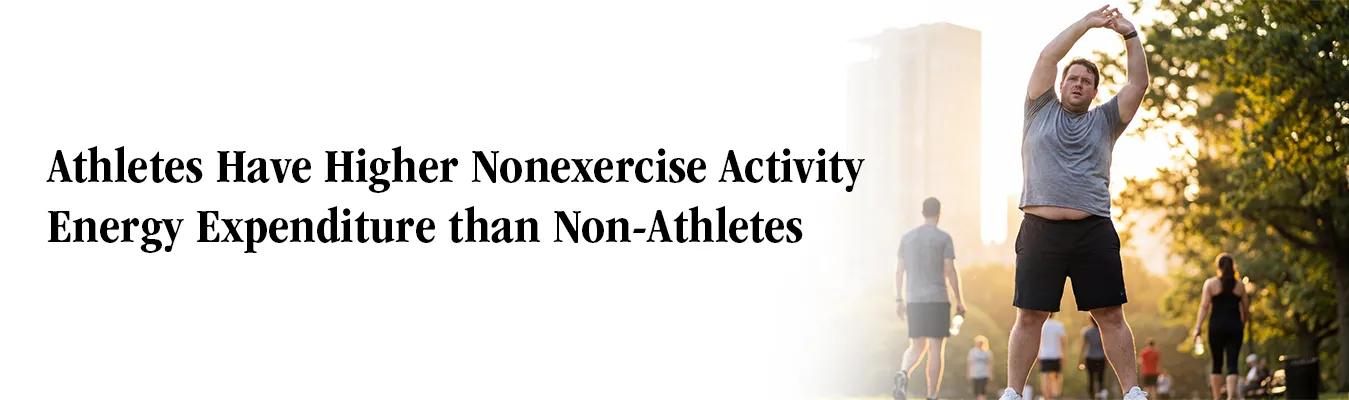

Athletes Have Higher Nonexercise Activity Energy Expenditure than Non-Athletes
Dr Rakesh Kumar Prasad, Head, Department of Endocrinology, Fortis Hospital, Noida
Collegiate athletes had higher daily nonexercise activity thermogenesis (NEAT) and spent more time in higher-intensity activities than sedentary men.
Athletes have high total energy expenditure, but little is known about the amount and intensity of non-exercise activity thermogenesis (NEAT) compared with non-athletes under real-life conditions.
Researchers studied 21 highly trained Japanese male collegiate athletes and 12 healthy sedentary male students. The study was conducted during the athletes’ regular training season under real-life conditions. All participants wore a validated triaxial accelerometer for 7 consecutive days. NEAT was calculated using metabolic equivalent of task (MET) data.
Daily NEAT was higher in athletes than in non-athletes, at 821 ± 185 kcal/day and 643 ± 164 kcal/day, respectively. When adjusted for body weight, daily NEAT was similar between the groups, at 10.5 ± 1.7 kcal/kg body weight/day in athletes and 10.4 ± 2.2 kcal/kg body weight/day in non-athletes.
NEAT per kilogram of body weight per hour was higher in athletes, at 0.81 ± 0.16 kcal/kg/h compared with 0.66 ± 0.12 kcal/kg/h in non-athletes.
The groups also differed in the intensity of their daily activity. Athletes spent less time in sedentary and light-intensity activities and more time in vigorous-intensity activities.
The researchers reported that athletes had similar daily NEAT relative to body weight. This was mainly due to differences in activity intensity, with athletes spending more time in moderate- and vigorous-intensity movement outside their scheduled exercise.
(Reference: Goshozono M, Miura N, Torii S, Taguchi M. Characteristics of non-exercise activity thermogenesis in male collegiate athletes under real-life conditions. Front Sports Act Living. 2024;6:1326890. Published 2024 Feb 13. doi:10.3389/fspor.2024.1326890
Recent FAQs

Related FAQs

Medtalks is India's fastest growing Healthcare Learning and Patient Education Platform designed and developed to help doctors and other medical professionals to cater educational and training needs and to discover, discuss and learn the latest and best practices across 100+ medical specialties. Also find India Healthcare Latest Health News & Updates on the India Healthcare at Medtalks







Please login to comment on this article