
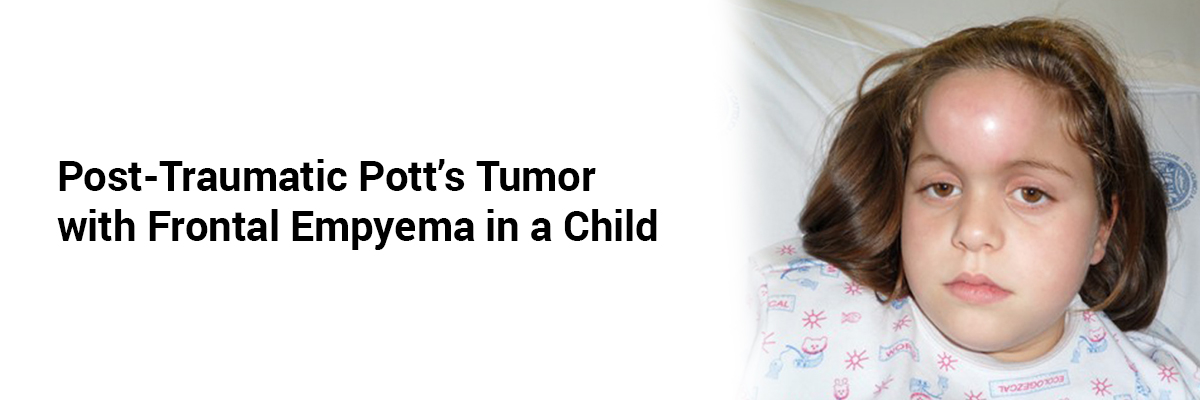

Post-Traumatic Potts Tumor with Frontal Empyema in a Child
Pott’s tumor is a subperiosteal abscess secondary to frontal sinus osteomyelitis. We report a 5-year-old child who developed Pott’s tumor complicated by a frontal empyema following craniofacial trauma. Combined medical and surgical treatment led to complete recovery without sequelae.
Introduction
Pott’s tumor results from osteomyelitis of the frontal sinus with anterior wall erosion and subperiosteal abscess formation. It is usually secondary to trauma or sinusitis and may lead to serious intracranial complications. We present a post-traumatic case in a 5-year-old child.
Clinical Case
A 5-year-old child presented with fever, headache, frontal swelling, and eyelid edema 15 days after a craniofacial trauma. Examination revealed a painful, erythematous frontal mass with purulent discharge. CT imaging showed frontal and ethmoidal sinus opacification, anterior table defect, a subperiosteal abscess (Pott’s tumor), and a frontal empyema.
IV antibiotics were started immediately. Surgical drainage was performed through frontal and nasal dorsum incisions. Culture was sterile. Recovery was uneventful, and follow-up at 6 months demonstrated complete clinical and radiological resolution.
Discussion
Although rare in children due to gradual frontal sinus development, Pott’s tumor can occur after sinusitis or trauma. Diagnosis relies on clinical suspicion and CT imaging to detect bone erosion and intracranial extension. Management requires broad-spectrum IV antibiotics and surgical drainage. Early treatment prevents serious complications and ensures good outcomes.
Conclusion
Pott’s tumor is an uncommon but serious condition in children. Prompt imaging, appropriate antibiotics, and timely surgical drainage result in excellent recovery, as demonstrated in this case.


Recent FAQs


Related FAQs



Medtalks is India's fastest growing Healthcare Learning and Patient Education Platform designed and developed to help doctors and other medical professionals to cater educational and training needs and to discover, discuss and learn the latest and best practices across 100+ medical specialties. Also find India Healthcare Latest Health News & Updates on the India Healthcare at Medtalks







Please login to comment on this article