
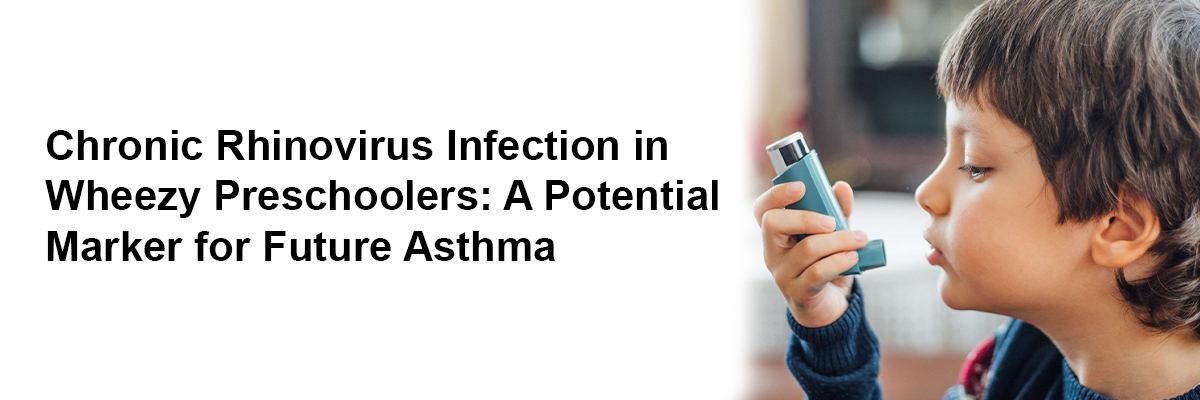

Chronic Rhinovirus Infection in Wheezy Preschoolers: A Potential Marker for Future Asthma
Indolent Rhinovirus infections will be predictive of the future development of persistent wheeze, potentially leading to asthma, according to the findings of a study presented at the 2024 Annual Scientific Meeting of the American College of Allergy, Asthma & Immunology held last month in Boston, USA.1
In this study of preschool children, 5 years and younger, with treatment-refractory wheeze, Rhinovirus was detected in 27% of bronchoalveolar lavage fluid samples despite the absence of clinical symptoms. The aim of this study was to investigate if this indolent Rhinovirus infection could help identify infants at ensuing risk for asthma supported by the emergence of an early type 2 (T2) inflammatory signature. A total of 468 children underwent BAL collection and phlebotomy to examine granulocyte counts and markers of inflammation. Eosinophilic activation and chemoattraction markers were determined via Quantitative PCR.
Infants with low-level Rhinovirus infection (RV+) showed no signs of systemic type 2 (T2) inflammation compared to RV-negative (RV-) participants, as indicated by similar blood eosinophil counts (280/µL in RV+ vs 210/µL in RV-), comparable total IgE levels (46 kU/L in RV+ vs 51 kU/L in RV-), and similar rates of atopy (48.8% in RV+ vs 51.8% in RV-). However, 30% of children with Rhinovirus exhibited eosinophilic airway inflammation compared to 23.2% of children without Rhinovirus. This airway eosinophilia was linked to a nearly four-fold increase in mRNA expression of CCL5 (RANTES), CCL11 (Eotaxin), CCL24 (Eotaxin-2), and IL-25, though levels of IL-33 and TSLP were not elevated.
This study demonstrates that indolent Rhinovirus infection is frequent in infants with treatment-refractory, recurrent wheezing. Although these children show no signs of a systemic type 2 inflammatory response, many of them show increased airway eosinophilia indicative of an emerging T2 inflammatory profile.
Reference: Offerle T. A007 Indolent rhinovirus infection is associated with increased airway eosinophilia in preschool children with recurrent wheeze. Ann Allergy Asthma Immunol. 2024 Nov.;133(6 Suppl): S4.


Recent FAQs




Related FAQs





Medtalks is India's fastest growing Healthcare Learning and Patient Education Platform designed and developed to help doctors and other medical professionals to cater educational and training needs and to discover, discuss and learn the latest and best practices across 100+ medical specialties. Also find India Healthcare Latest Health News & Updates on the India Healthcare at Medtalks







Please login to comment on this article