

 IJCP Editorial Team
Optimizing Nutrition in Preterm Infants: Day-1 Full Feeding Compared with Gradual Feeding
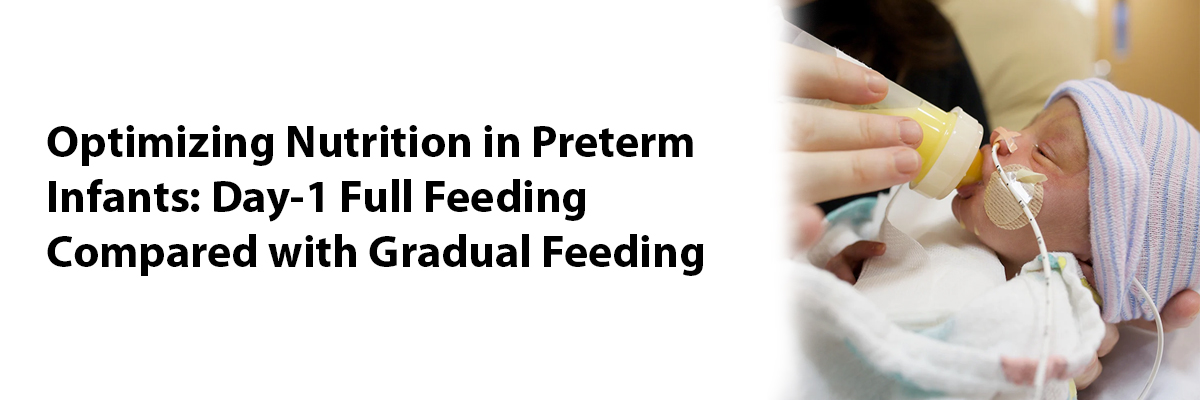
Preterm infants are often given intravenous fluids or parenteral nutrition while milk feeds are gradually increased. Starting full milk feeds sooner could potentially reduce hospital stay and lower the risk of infections, but might increase the risk of necrotising enterocolitis.
A recent study published in The Lancet Child & Adolescent Health investigated whether providing exclusively enteral fluids from day 1, compared with gradual feeding supplemented by intravenous fluids or parenteral nutrition, affects hospital stay in infants born between 30+0 and 32+6 weeks of gestation.
In this open-label, multicentre, randomized trial, 1,761 mothers from 46 UK neonatal units were recruited between October 2019 and July 2024, enrolling 2,088 preterm infants (1,047 assigned to full milk feeds, 1,041 to gradual feeding). Eligible infants were under three hours old and clinically stable, while those with congenital anomalies or abnormal blood flow were excluded. Randomisation occurred within three hours of birth using a web-based system. Full milk feeds started at 60–80 mL/kg per day, and gradual feeding began at a maximum of 30 mL/kg per day with intravenous or parenteral support. The primary outcome was length of hospital stay, with hypoglycaemia and necrotising enterocolitis monitored as safety outcomes. Mean gestational age, birthweight, and sex distribution were similar. There was no difference in hospital stay (32.4 vs 32.1 days; adjusted difference –0.02 days; 95% CI –1.07 to 1.03; p=0.97), and safety outcomes were comparable.
The results concluded that in preterm infants of 30–32 weeks, starting full milk feeds from day 1 does not reduce hospital stay and is not associated with an increased risk of necrotising enterocolitis or hypoglycaemia.
References:
1. Ojha S, McIntyre J, et al. Full exclusively enteral fluids from day 1 versus gradual feeding in preterm infants (FEED1): an open-label, parallel-group, multicentre, randomised, superiority trial. Lancet Child Adolesc Health. 2025;9(12):827 836.; https://www.thelancet.com/journals/lanchi/article/PIIS2352-4642(25)00271-8/fulltext
IJCP Editorial Team
Comprising seasoned professionals and experts from the medical field, the IJCP editorial team is dedicated to delivering timely and accurate content and thriving to provide attention-grabbing information for the readers. What sets them apart are their diverse expertise, spanning academia, research, and clinical practice, and their dedication to upholding the highest standards of quality and integrity. With a wealth of experience and a commitment to excellence, the IJCP editorial team strives to provide valuable perspectives, the latest trends, and in-depth analyses across various medical domains, all in a way that keeps you interested and engaged.
More FAQs by IJCP Editorial Team





Recent FAQs


Related FAQs










Medtalks is India's fastest growing Healthcare Learning and Patient Education Platform designed and developed to help doctors and other medical professionals to cater educational and training needs and to discover, discuss and learn the latest and best practices across 100+ medical specialties. Also find India Healthcare Latest Health News & Updates on the India Healthcare at Medtalks







Please login to comment on this article