
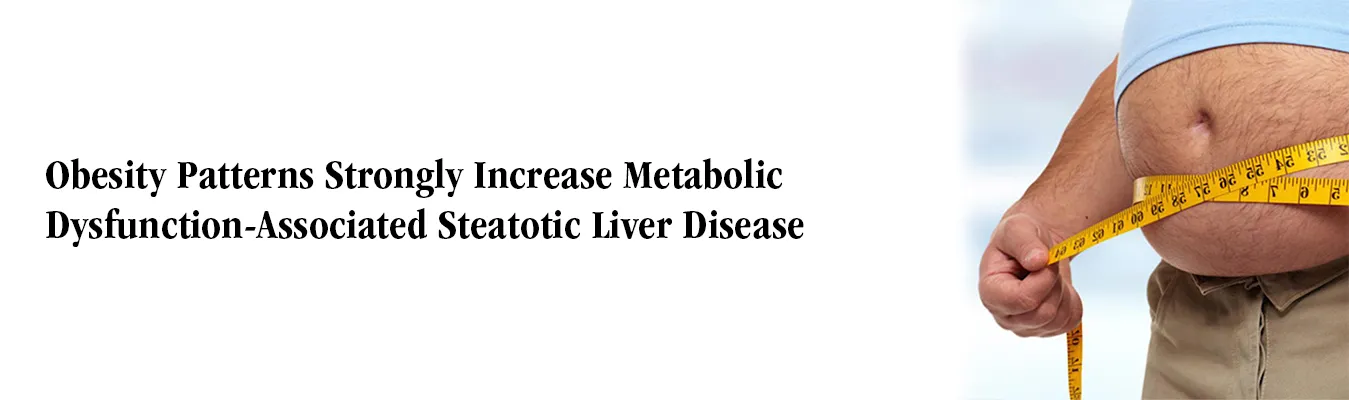

Obesity Patterns Strongly Increase Metabolic Dysfunction-Associated Steatotic Liver Disease
Different forms of obesity, especially combined and abdominal obesity, are strongly linked with higher Metabolic Dysfunction-Associated Steatotic Liver Disease (MASLD), risk in US adults.
Obesity is a major global public health concern and is closely linked with nonalcoholic fatty liver disease (NAFLD), a condition where fat builds up in the liver. However, evidence on how different obesity patterns affect MASLD risk is still limited.
A study published in BMC Gastroenterology aimed to examine the relationship between different obesity patterns and MASLD risk in a large male population in the United States. It used data from the 2017 to March 2020 National Health and Nutrition Examination Survey (NHANES). Liver fat and fibrosis were measured using FibroScan, based on controlled attenuation parameter (CAP) and liver stiffness measurement (LSM). MASLD was defined using a CAP value of 248 dB/m or higher. Obesity patterns were defined using body mass index (BMI) and waist circumference (WC), and participants were grouped into overweight, general obesity, abdominal obesity, and combined obesity categories.
A total of 5,858 adults were included. Compared with normal weight individuals, the risk of MASLD was significantly higher in all obesity groups. Odds ratios were 6.90 for overweight, 2.84 for general obesity, 3.02 for abdominal obesity, and 9.53 for combined obesity. Waist circumference was also strongly linked with MASLD risk and showed good diagnostic performance with an area under the curve of 0.802.
In conclusion, all obesity patterns increase MASLD risk and waist circumference is a simple but powerful indicator for identifying MASLD risk.
(Reference: Sun J, Yan C, Wen J, Wang F, Wu H, Xu F. Association between different obesity patterns and the risk of NAFLD detected by transient elastography: a cross-sectional study. BMC Gastroenterol. 2024;24(1):221. Published 2024 Jul 10. doi:10.1186/s12876-024-03303-x )
Recent FAQs


Related FAQs







Medtalks is India's fastest growing Healthcare Learning and Patient Education Platform designed and developed to help doctors and other medical professionals to cater educational and training needs and to discover, discuss and learn the latest and best practices across 100+ medical specialties. Also find India Healthcare Latest Health News & Updates on the India Healthcare at Medtalks







Please login to comment on this article