

 IJCP Editorial Team
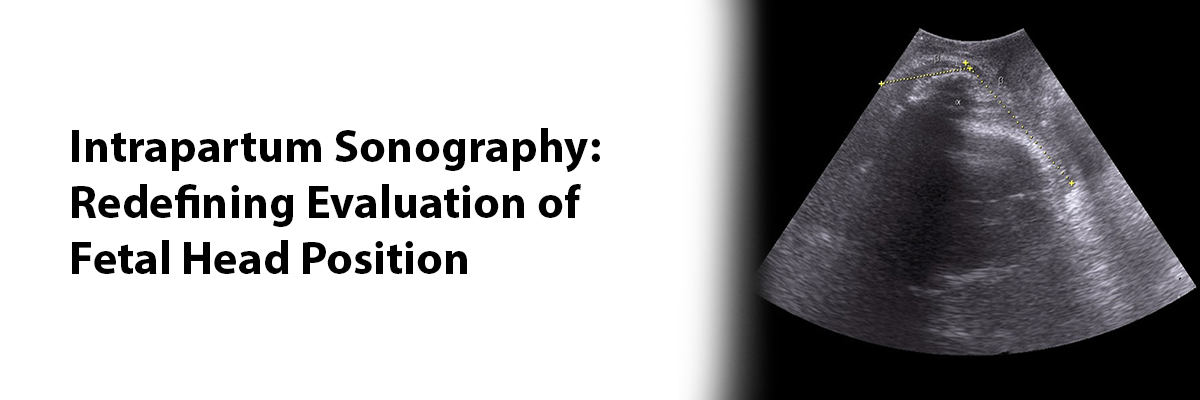
Intrapartum Sonography: Redefining Evaluation of Fetal Head Position
Prolonged or
arrested labor remains one of the most challenging intrapartum scenarios faced
by obstetric clinicians. Among the leading contributors are fetalmalpresentation,
malposition, and asynclitism—conditions that historically depend on subjective
and often inconsistent vaginal examination for diagnosis. As labor management
evolves, so too must our diagnostic strategies. In this context, intrapartum sonography
has emerged as a pivotal tool, offering objectivity, reproducibility, and
improved accuracy in assessing the fetal head position and attitude.
Over the past
decade, robust evidence has demonstrated that ultrasound surpasses clinical
examination in identifying cephalic malposition. Several international
guidelines now recommend using sonography—particularly before instrumental
delivery—to confirm fetal occiput position. The technique is not only more
precise but also feasible: basic assessment of occiput position can be mastered
even by clinicians with foundational ultrasound skills. A simple transabdominal
scan in axial and sagittal planes, with the probe placed suprapubically, can
reliably identify key anatomical landmarks such as the orbits, midline
structures, cerebellum, and cervical spine.
However, more
complex assessments—such as diagnosing cephalic malpresentation (sinciput,
brow, or face) or detecting asynclitism—require greater expertise. Recent work
has introduced objective sonographic parameters like the occiput–spine angle
and chin–chest angle, offering quantifiable metrics to evaluate fetal head
deflexion. Similarly, the diagnosis of asynclitism gains clarity through
combined transabdominal and transperineal views, where findings such as the
“squint sign” or displaced sagittal suture provide definitive clues.
The clinical
implications are significant. Accurate intrapartum diagnosis informs timely
decision-making, improves anticipation of labor progression, and may help
stratify women at risk of operative birth or labor arrest. For those
experiencing a protracted active phase, detailed sonographic evaluation may
help identify the underlying cause—guiding individualized and safer management
strategies.
As obstetric
practice continues its shift toward precision-based care, intrapartum
sonography stands as an essential companion. It enhances both the safety and
quality of labor management while reducing reliance on subjective clinical
impressions. Integrating these techniques into routine practice—and ensuring
appropriate training pathways—will be key to optimizing maternal and neonatal
outcomes in the years ahead.
IJCP Editorial Team
Comprising seasoned professionals and experts from the medical field, the IJCP editorial team is dedicated to delivering timely and accurate content and thriving to provide attention-grabbing information for the readers. What sets them apart are their diverse expertise, spanning academia, research, and clinical practice, and their dedication to upholding the highest standards of quality and integrity. With a wealth of experience and a commitment to excellence, the IJCP editorial team strives to provide valuable perspectives, the latest trends, and in-depth analyses across various medical domains, all in a way that keeps you interested and engaged.
More FAQs by IJCP Editorial Team








Recent FAQs

Related FAQs









Medtalks is India's fastest growing Healthcare Learning and Patient Education Platform designed and developed to help doctors and other medical professionals to cater educational and training needs and to discover, discuss and learn the latest and best practices across 100+ medical specialties. Also find India Healthcare Latest Health News & Updates on the India Healthcare at Medtalks







Please login to comment on this article