

Understanding The Infant Skin Microbiome—Current Insights And Emerging Challenges
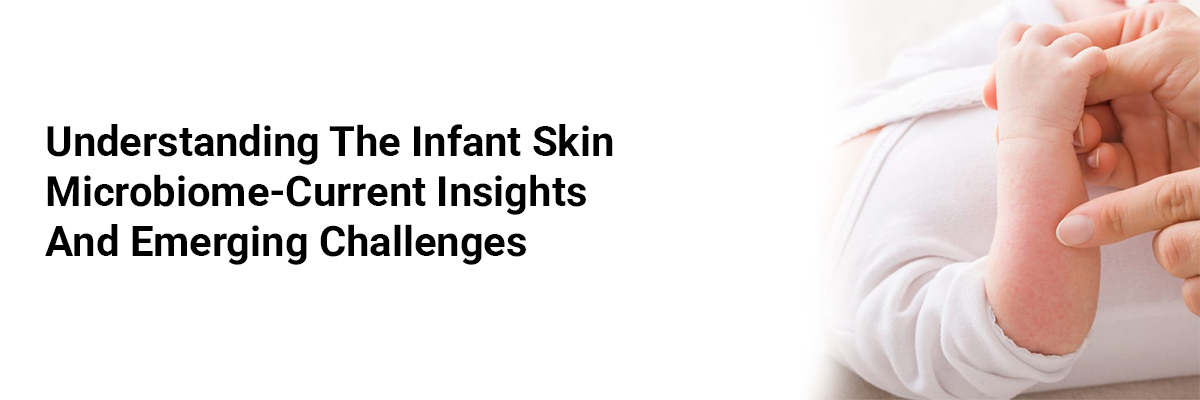
Recent advancements in microbiome research have brought renewed focus on the infant skin microbiome—an intricate ecosystem of bacteria, fungi, viruses, and archaea that plays a critical role in skin health and immunity. A comprehensive review by Serghiou et al.,1 offers a timely update on this evolving field, summarizing current findings, ongoing research limitations, and future directions.
At birth, the infant skin microbiome is primarily dominated by coagulase-negative Staphylococcus species and Lactobacillus iners. Over time, these early colonizers are replaced by genera such as Acinetobacter, Streptococcus, Veillonella, and Bifidobacterium. Preterm infants, in particular, display more diverse and potentially pathogenic microbial communities due to their vulnerable skin barrier and prolonged hospital stays.
Several intrinsic and extrinsic factors influence the development of the skin microbiome in early life. These include mode of delivery, antibiotic exposure, breastfeeding, maternal health, and environmental exposures such as pets or hospital environments. For instance, delivery by cesarean section is associated with a higher abundance of Streptococcus on the skin, and antibiotic exposure may transiently reduce microbial diversity.
The review highlights that much of the current research is geographically skewed towards high-income countries. Moreover, studies remain heavily focused on bacterial communities, with the mycobiome, virome, and archaeome being comparatively underexplored. Integrative approaches that combine metagenomics, metabolomics, and culturomics are now emerging and offer a more holistic understanding of the microbial ecosystem.
Importantly, there is growing interest in probiotic interventions—both oral and topical—targeting skin diseases such as atopic dermatitis (AD). While some trials show promise in modulating the skin microbiome and improving disease outcomes, further large-scale, controlled studies are needed.
Despite the progress, significant research gaps remain. Technical challenges, such as low microbial biomass and suboptimal DNA extraction methods, continue to hinder data quality. Additionally, distinguishing between microbiome-driven and microbiome-independent cases of skin disease is an area that warrants further investigation.
Lastly, it was noted that advancing our understanding of how the infant skin microbiome contributes to immunity and disease risk will require global, longitudinal studies with standardized methodologies. Doing so holds the promise of improving neonatal skincare practices and developing targeted therapies for long-term health benefits.
(Source: Serghiou IR, Webber MA, Hall LJ. An update on the current understanding of the infant skin microbiome and research challenges. Curr Opin Microbiol. 2023;75:102364. doi:10.1016/j.mib.2023.102364. Available from: https://www.sciencedirect.com/science/article/pii/S1369527423001017 )


Recent FAQs

Related FAQs









Medtalks is India's fastest growing Healthcare Learning and Patient Education Platform designed and developed to help doctors and other medical professionals to cater educational and training needs and to discover, discuss and learn the latest and best practices across 100+ medical specialties. Also find India Healthcare Latest Health News & Updates on the India Healthcare at Medtalks







Please login to comment on this article