
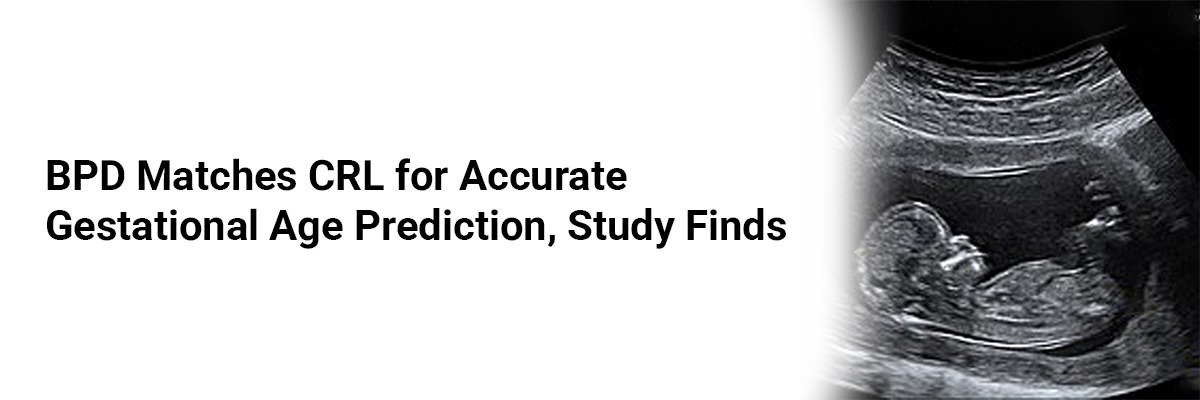

BPD Matches CRL for Accurate Gestational Age Prediction, Study Finds
Biparietal diameter (BPD) is as precise as crown–rump length (CRL) for fetal dating in the late first trimester, according to a study published in the December 2024 issue of Ultrasound in Obstetrics & Gynecology.¹
The study evaluated the accuracy of gestational age estimation and predicted estimated due dates (EDD) using BPD compared with CRL in the late first and early second trimesters, employing a population-based design.
Gestational age and term prediction curves were developed using data from 11,041 pregnancies, incorporating 12,260 CRL and/or BPD measurements sourced from a Norwegian population-based clinical database. Precision was assessed by estimating and comparing prediction residual curves through time-to-event analysis. Differences in gestational age predictions between CRL and BPD were analyzed using measurements obtained from the same fetus on the same day. A sensitivity analysis examined the effect of misclassifying spontaneous and non-spontaneous births.
CRL and BPD showed nearly identical precision in predicting term, demonstrated by the similarity of their residual distributions. In 51% of examinations, gestational age predictions differed by 1 day or less. Differences of 2 days occurred in 24% of cases, 3 days in 14%, 4 days in 7%, and only 5% showed a discrepancy of 5 days or more. Incorrectly excluding induced births or misclassifying them as spontaneous introduced a systematic prediction bias of approximately 2 days.
The authors conclude that BPD and CRL offer comparable accuracy in estimating gestational age and predicting term. They note that “the measurement of BPD can replace the measurement of CRL” as a standard parameter because BPD is technically easier to perform and can be reliably measured throughout pregnancy.
Reference
1. Gjessing HK, et al. Biparietal diameter vs crown–rump length as standard parameter for late first-trimester pregnancy dating. Ultrasound Obstet Gynecol. 2024 Dec;64(6):739-745. doi: 10.1002/uog.29124.


Recent FAQs




Related FAQs










Medtalks is India's fastest growing Healthcare Learning and Patient Education Platform designed and developed to help doctors and other medical professionals to cater educational and training needs and to discover, discuss and learn the latest and best practices across 100+ medical specialties. Also find India Healthcare Latest Health News & Updates on the India Healthcare at Medtalks







Please login to comment on this article