

Trachelectomy as a Definitive Treatment for Cervical Descent Post-SCH
A 55-year-old postmenopausal woman presented to a tertiary care center with a two-year history of a mass protruding per vaginam. She had attained menopause 10 years earlier and had two previous vaginal deliveries, the last occurring 28 years ago. Her surgical history included laparoscopic sterilization 26 years earlier and an abdominal hysterectomy for fibroids 10 years prior. She was recently diagnosed with hypertension, four months before presentation.
On examination, her BMI was 23.4 kg/m². Abdominal examination revealed a soft, non-tender abdomen with a transverse surgical scar. Pelvic examination showed the cervix at the level of the external os with a grade III cystocele and no evidence of stress urinary incontinence. The uterine sound could not be advanced beyond one centimeter, suggesting cervical stenosis; the cervix was non-tender.
Routine laboratory investigations, including complete blood count and liver and kidney function tests, were within normal limits. However, blood glucose was elevated with an HbA1c of 10%. Urinalysis revealed no ketones, and urine culture was sterile. Pap smear was negative for intraepithelial lesion or malignancy. Ultrasound imaging demonstrated a small cervical stump measuring approximately two centimeters.
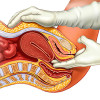
Given the history of supracervical hysterectomy (SCH) and the presence of cervical descent with cystocele, the patient underwent vaginal trachelectomy with anterior colporrhaphy. Intraoperatively, the cervical stump measured four centimeters, with grade III cystocele and no enterocele. The procedure involved meticulous dissection of the bladder from the cervical stump, identification of the uterosacral ligaments, excision of the stump, and closure of the vaginal mucosa. Histopathology confirmed chronic cervicitis.
The postoperative recovery was uneventful. The Foley catheter was removed after 48 hours, and at the six-month follow-up, the patient remained asymptomatic.
Conclusion:
Vaginal trachelectomy is a safe and effective approach for managing cervical stump prolapse following SCH. It allows concurrent repair of associated pelvic floor defects, providing excellent anatomical and functional outcomes.
Source: Ballal P, Pandit MD. Indian Obstetrics and Gynaecology. 2024 Jul 23;14(2).

Recent FAQs




Related FAQs





Medtalks is India's fastest growing Healthcare Learning and Patient Education Platform designed and developed to help doctors and other medical professionals to cater educational and training needs and to discover, discuss and learn the latest and best practices across 100+ medical specialties. Also find India Healthcare Latest Health News & Updates on the India Healthcare at Medtalks







Please login to comment on this article