

Published On: 17 Nov, 2025 4:26 PM | Updated On: 15 Nov, 2025 5:41 PM
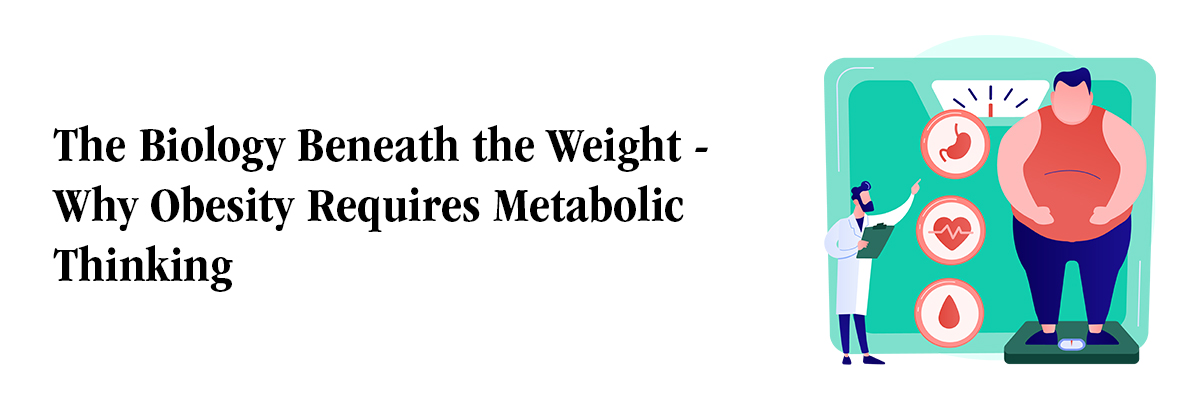
The Biology Beneath the Weight — Why Obesity Requires Metabolic Thinking
Dr. Lakshmi Nagendra and Dr. Sanjay Kalra
Obesity is a biologically driven metabolic disorder shaped by disrupted appetite signals and hormonal pathways, not a failure of willpower.
The science of obesity continues to dismantle the myth of “eat less, move more” as a sufficient explanation. Modern findings highlight a physiology wired for survival — not an individual failure of willpower. Excess nutrition and sedentary behaviors disturb central appetite circuits, reducing the ability of leptin to cross the blood–brain barrier and weakening satiety signals, with transport efficiency falling by nearly 80% in obesity.
Insulin signaling, usually responsible for promoting satiety and balancing nutrient use, becomes impaired as chronic overeating, inactivity, and sleep loss drive insulin resistance and free fatty acid overflow into non-adipose tissues, causing lipotoxic stress. Ghrelin pathways also shift in response to energy imbalance, with diminished receptor sensitivity encouraging hunger dysregulation.
At the hormonal and neural level, opposing POMC and NPY/AgRP pathways in the hypothalamus become desensitized under chronic overnutrition, blunting metabolic control and amplifying appetite signals. This cascade extends beyond hunger — inflammation, mitochondrial stress, altered circadian signaling, and gut microbial shifts reinforce a cycle of metabolic dysfunction.
Obesity, therefore, emerges not as a moral weakness but as a biologically adaptive system overwhelmed by modern environments. Clinical conversations must reflect this reality: sustainable care means addressing metabolic pathways, sleep, stress, and central appetite biology — not blaming weight, but treating a chronic metabolic disease.
(Source: Kong Y, Yang H, Nie R, Zhang X, Zuo F, Zhang H, Nian X. Obesity: pathophysiology and therapeutic interventions. Mol Biomed. 2025;6(1):1-41.)
Recent FAQs





Related FAQs







Medtalks is India's fastest growing Healthcare Learning and Patient Education Platform designed and developed to help doctors and other medical professionals to cater educational and training needs and to discover, discuss and learn the latest and best practices across 100+ medical specialties. Also find India Healthcare Latest Health News & Updates on the India Healthcare at Medtalks







Please login to comment on this article