
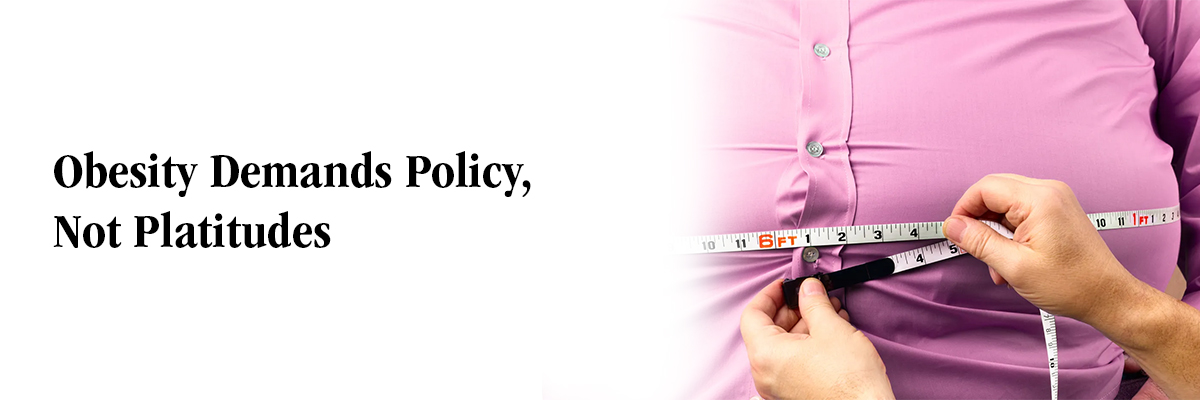

Obesity Demands Policy, Not Platitudes
Dr Madhur Verma and Dr Sanjay Kalra
Obesity is a chronic disease that demands bold policy action, not lifestyle rhetoric, to drive equitable prevention and treatment
Obesity is no longer a slow-burning public health concern; it is a structural crisis fuelled by food systems, inequity, and policy inertia. Treating it as a lifestyle issue has cost health systems precious time and human lives. Despite a clear scientific consensus that obesity is a chronic, progressive disease with metabolic, hormonal, and environmental roots, many national frameworks still fail to recognize it, allowing stigma to substitute for strategy. When policy lags behind biology, prevention stalls, treatment access remains uneven, and health inequities deepen.
Global commitments have acknowledged tobacco, diabetes, and cardiovascular disease — yet obesity remains curiously absent from core non-communicable disease mandates. As ultra-processed food marketing expands and urban environments discourage physical activity, low- and middle-income countries face rising prevalence without the system capacity to respond. Recognizing obesity as a disease is more than a classification exercise; it determines whether governments invest in surveillance, primary-care integration, regulatory reform, and trained multidisciplinary teams.
The opportunity ahead is not incremental; it is transformational. Embedding obesity within national NCD agendas, financing prevention and treatment, and legislating healthier environments are essential steps toward population well-being and economic resilience. Policy silence sustains the epidemic. Recognition can reverse it — if leaders choose action over avoidance.
A disease deserves a disease response — with prevention, treatment, dignity, and policy ambition to match its scale.
Source: Chandiwana N, Barquera S, Baur L, Buse K, Halford J, Halpern B, Jackson-Morris A, Mbanya JC, Nece P, Ralston J. Obesity is a disease: global health policy must catch up. Lancet Glob Health. 2025;13(10):e1659-60.)
Recent FAQs

Related FAQs







Medtalks is India's fastest growing Healthcare Learning and Patient Education Platform designed and developed to help doctors and other medical professionals to cater educational and training needs and to discover, discuss and learn the latest and best practices across 100+ medical specialties. Also find India Healthcare Latest Health News & Updates on the India Healthcare at Medtalks







Please login to comment on this article