
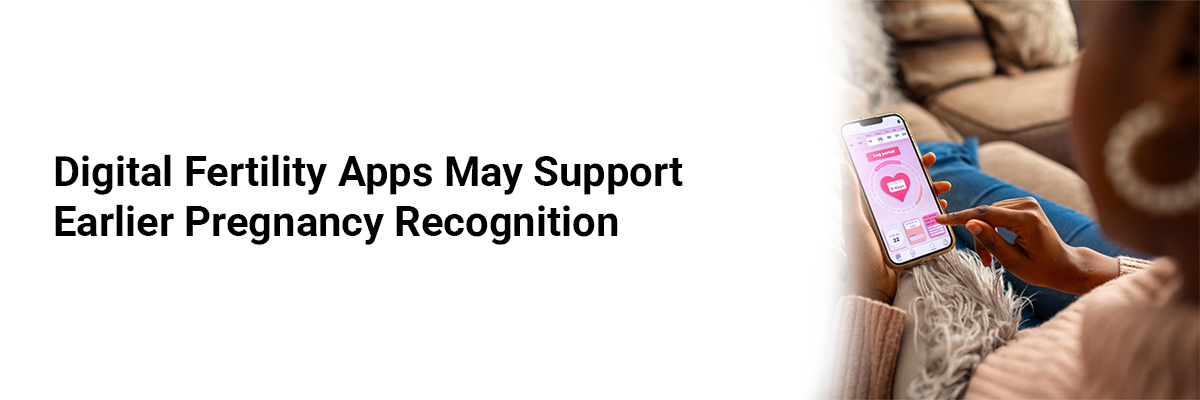

Digital Fertility Apps May Support Earlier Pregnancy Recognition
Early recognition of pregnancy is key to improving outcomes, reducing risks, and expanding treatment options. While prior studies relied on surveys or clinical data, little is known about pregnancy recognition in the context of digital fertility apps.
An analysis of 23,728 pregnancies from 20,429 users of Food and Drug Administration (FDA) approved app found that those trying to conceive recognized pregnancy on average 31.3 days from their last menstrual period, compared with 35.9 days among those using the app to prevent pregnancy. Time-to-pregnancy recognition was compared between individuals using the app to conceive versus to prevent pregnancy, using two-tailed Welch’s t-tests, Mann–Whitney U-tests, and two-tailed Z-tests.
This study shows that users of a digital fertility app who were trying to conceive recognized pregnancy about 4–5 days earlier than those using it to prevent pregnancy, suggesting that such apps may support earlier recognition and more timely prenatal care. However, generalizability is limited by the homogeneous study population.
Reference:
Van Lamsweerde A, Pearson JT, Urrutia R, Gemzell-Danielsson K, Kopp Kallner H, Nelson A, Benhar E, Favaro C, Berglund Scherwitzl E, Scherwitzl R. Time to pregnancy recognition among users of an FDA-cleared fertility application. Journal of obstetrics and GynaecoloGy. 2024 Dec 31;44(1):2337687.
https://www.tandfonline.com/doi/full/10.1080/01443615.2024.2337687#d1e566

Recent FAQs




Related FAQs








Medtalks is India's fastest growing Healthcare Learning and Patient Education Platform designed and developed to help doctors and other medical professionals to cater educational and training needs and to discover, discuss and learn the latest and best practices across 100+ medical specialties. Also find India Healthcare Latest Health News & Updates on the India Healthcare at Medtalks







Please login to comment on this article