
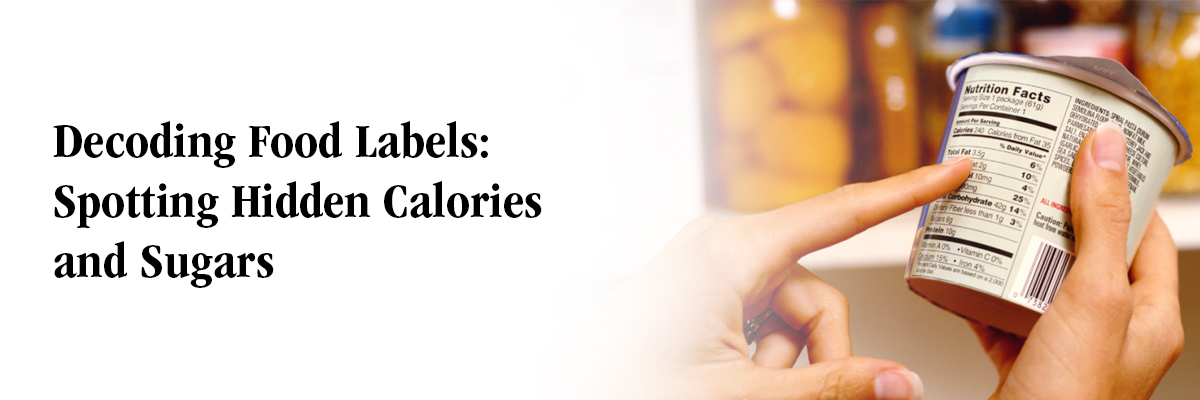

Decoding Food Labels: Spotting Hidden Calories and Sugars
Have you ever picked up a packet of biscuits, breakfast cereal, fruit juice, or “health drink” and thought, “This sounds healthy” only to later discover it was quietly packed with sugar and calories?
Modern food
labels can be confusing, and many unhealthy products are cleverly marketed as
nutritious. Learning how to read food labels correctly is one of the most
powerful skills you can develop for protecting your weight, blood sugar, heart
health, and overall wellbeing.
Let’s decode what food labels really tell you and
what they don’t.
Ø Food
Labels Matter More Than You Think
Food package labels play a crucial role in promoting healthy
dietary choices by providing essential nutritional information encouraging a
balanced diet.
Every packaged food carries important information about its calories, sugar, fat, fibre, salt, and nutrients. When used correctly, food labels allow you to compare products and choose options that support better weight control, blood sugar, heart health, and overall wellbeing.This is especially important for individuals with health conditions such as diabetes, high cholesterol, obesity, hypertension, or heart disease, who need to be more careful about what they eat. Food labels help identify which products are safer and which ones may worsen their condition.

Figure 1: Key Elements of a food label
Ø Interpreting
Food Labels
Reading food labels is not always easy. Research shows that people with more nutrition knowledge find labels easier to understand, while older adults and those with less exposure to health information may struggle.
In countries like India, food
labels may sometimes be incomplete or written in a way that is difficult to
interpret, making it even more important to learn what the numbers and terms
really mean.
Also, most people do glance at food labels often overlooking the hidden sugars, trans-fats and calories. Understanding what to look for and how to interpret it is the key.
Ø Spotting
Hidden Calories and Sugars
Hidden calories and sugars are one of the biggest drivers of
weight gain, diabetes, fatty liver disease, and heart disease. Even people who
eat “small portions” can unknowingly consume excess calories simply because
packaged foods are energy-dense and sugar-rich.
For an instance, a food may look harmless like flavored yogurt, granola bars, breakfast cereals, or fruit juices but these can contain as much sugar as a soft drink. The only way to know is to read the label.

Figure 2: A practical example of label-based nutrition assessment
Learn what to
look for on the label
Once you turn a food package around, the Nutrition Facts label gives you powerful clues about whether a product is truly healthy.

Figure 3:Reading
a food label
1. Start with the serving information
Always look
at the serving size and number of servings per pack.The
serving size shows how much people usually eat at one time, not necessarily how
much is in the entire packet.
If a pack contains two or three servings and you
eat the whole thing, you are actually consuming two or three times the
calories, sugar, and fat listed on the label.
2. Check the total calories
Look at how
many calories are in one serving
and then think about how much you will actually eat.
If one serving contains 150 calories but you eat
two servings, you are really consuming 300
calories.
3. Choose your nutrients
Some
nutrients should be kept low to protect your heart and blood sugar.
- Focus on saturated
fat and trans-fat, not
just total fat.
- Avoid trans-fat
completely.
Even if the label says “0 g trans-fat,” check the ingredient list. If it includes “partially hydrogenated oil,” the food still contains trans-fat.
- Limit added sugars*,
saturated fat, and sodium as
much as possible. Compare similar products and choose the one with lower sugar, salt, and unhealthy fat.
* Total sugars include both
natural and added sugars. Added sugars are the ones that raise blood
sugar and promote weight gain.
Look for beneficial nutrients. Choose foods
that provide:
- Dietary fibre
- Calcium
- Iron
- Potassium
- Vitamin D
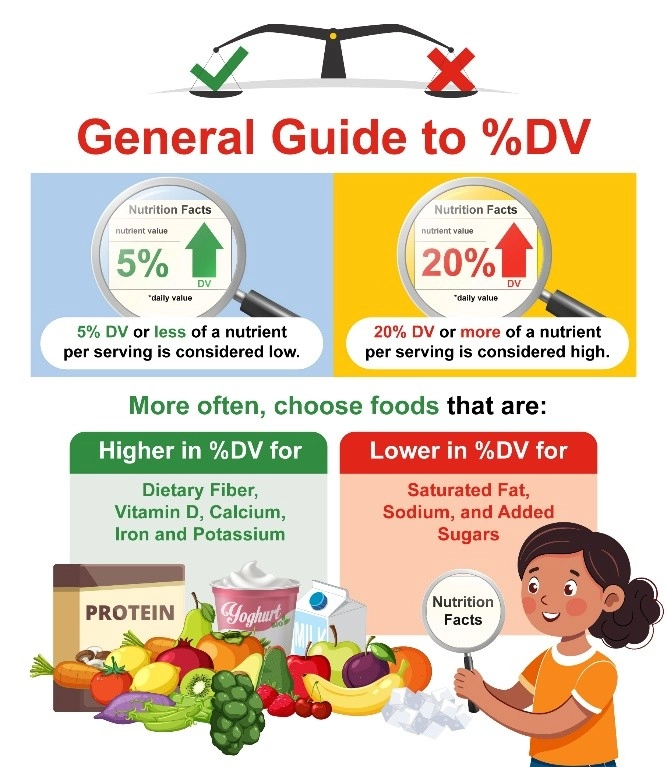
The % Daily Value shows how much of a nutrient one serving gives you compared to what you need in a whole day.
So, if you want to eat less sugar or sodium, choose foods with a low %DV. If you want more fibre or nutrients, choose foods with a high %DV.
Figure 4:Understanding %DV
Smart Label
Reading Tips
1. Don’t be fooled by the front
of the pack
Food packages are designed to sell, not to educate.
Words like “low fat,” “no added sugar,” “natural,” “high
fibre,” “energy booster,” “for diabetics,” or “heart healthy” may sound
reassuring, but they do not guarantee that a product is good for you.
A low-fat food may contain more sugar to improve taste. “No
added sugar” can still mean sugar from honey, fruit juice concentrates, or
syrups. And “natural” does not mean low-calorie or safe for people with
diabetes.
The real nutritional truth is always found on
the back of the pack, not the front.
2. Understand calories
Calories tell you how much energy the food provides. Extra
calories that your body does not use get stored as fat.
|
As a simple guide: |
|
|
·
Less than 100 kcal
per serving = low ·
100–200 kcal = moderate · More than 200 kcal = high for a snack
|
|
Figure 5:Simple
Guide for Calorie Intake
Many “healthy” snacks like granola bars or
protein cookies can contain 250–400 calories, which is similar to a full
meal. |
|

3. Watch out for hidden sugars
Look for both total sugar and added sugar on labels.
What makes sugar especially misleading is that it appears under many different names. On ingredient lists, sugar may be listed as sucrose, glucose, fructose, honey, syrup, dextrose, maltose, fruit juice concentrate, or jaggery. Even though some of these sound natural, they all raise blood sugar and add empty calories.

Figure 6:Sugars in food: Understanding Total Sugar and Added Sugar
4. Read the ingredient list
carefully
Ingredients are listed in order of quantity, from highest to
lowest.If sugar or refined flour (maida) appears among the first few
ingredients, the food is not a healthy choice.Look for foods that list whole
grains, nuts, seeds, pulses, milk, curd, or whole fruits as main ingredients.
5. Look beyond carbohydrates
and fats
Choose foods that are high in fibre and low in refined
carbohydrates and unhealthy fats. Refined starches and sugars behave the same
in the body and promote weight gain.
“Healthy eating doesn’t require extreme
dieting—it requires informed choices.”
References:
1.
M A, Varakumari E, Thozhanenjan
I, M V, Pandian S, Bhandari A, Grace A. Decoding Food Labels: A Study on the
Knowledge, Attitudes, and Practices of Young Medical Students in Chennai.
Cureus. 2025 Apr 20;17(4):e82657. doi: 10.7759/cureus.82657. PMID: 40400878;
PMCID: PMC12092957.
2. U.S. Food and Drug
Administration. How to Understand and Use the Nutrition Facts Label. Available
from: https://www.fda.gov/food/nutrition-facts-label/how-understand-and-use-nutrition-facts-label
3. American Heart Association.
Understanding Food Nutrition Labels. Available from: https://www.heart.org/en/healthy-living/healthy-eating/eat-smart/nutrition-basics/understanding-food-nutrition-labels
4.
Food Safety Standard.
Components of a Food Label. Available from: https://foodsafetystandard.in/components-of-a-food-label/
5. Food and Agriculture Organization of the United Nations. Food labelling. Available from: https://www.fao.org/food-labelling/en
6. Eat Right India. How to read label. Available from: https://eatrightindia.gov.in/how-to-read-label.jsp
7. NHS. How to read food labels. Available from: https://www.nhs.uk/live-well/eat-well/food-guidelines-and-food-labels/how-to-read-food-labels/
8. NHS Inform. Food labelling. Available from: https://www.nhsinform.scot/healthy-living/food-and-nutrition/food-packaging/food-labelling
Recent FAQs




Related FAQs






Medtalks is India's fastest growing Healthcare Learning and Patient Education Platform designed and developed to help doctors and other medical professionals to cater educational and training needs and to discover, discuss and learn the latest and best practices across 100+ medical specialties. Also find India Healthcare Latest Health News & Updates on the India Healthcare at Medtalks







Please login to comment on this article