
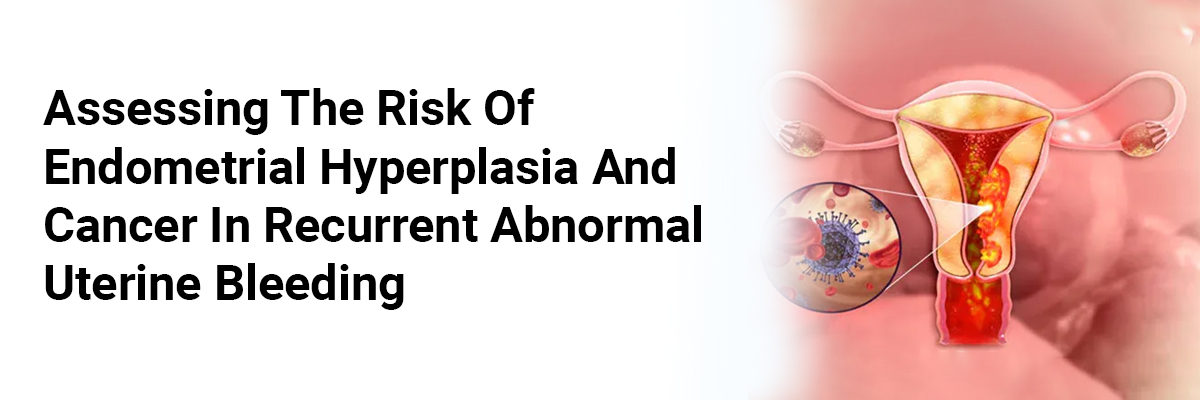

Assessing the Risk of Endometrial Hyperplasia and Cancer in Recurrent Abnormal Uterine Bleeding
Older age, nulliparity, a history of endometrial polyps, and a short
interval between endometrial samplings (less than 12 months) are significant
predictors of endometrial hyperplasia and endometrial cancer in women with
recurrent abnormal uterine bleeding (AUB) and previously benign endometrial
findings. These findings were reported in a study published on August 1, 2024,
in Obstetrics & Gynecology.¹
This retrospective study from Thailand aimed to develop predictive models
to assess the risk of endometrial hyperplasia and endometrial cancer in women
presenting with recurrent AUB after a prior benign endometrial sampling. The
study included patients who had undergone initial benign endometrial sampling
between January 2013 and December 2021. Using multivariate logistic regression,
the researchers identified key risk factors and created a scoring system to
stratify patients into risk categories.
Among the 456 patients included in the study, 8.3% developed endometrial
hyperplasia and 2.2% developed endometrial cancer. The average interval between
the first and second endometrial sampling was 25.1 months.
Key findings include:
- Women
older than 45 years had nearly a threefold increased risk (OR 2.86).
- Nulliparous
women had a 3.5-fold higher risk (OR 3.50).
- A
history of endometrial polyps increased the risk more than threefold (OR
3.69).
- Women
who underwent repeat sampling within 12 months had over twice the risk (OR
2.36).
Based on these predictors, a risk scoring system was developed. Patients
were stratified into three risk categories:
- Low
risk (0–3 points): 4.7% probability
- Intermediate
risk (5–8 points): 15.5% probability
- High
risk (9–11 points): 57.1% probability
The model demonstrated good discriminatory power, with an area under the
curve (AUC) of 73.1% and a mean absolute error of 0.01.
This study underscores the importance of risk stratification in women
with recurrent AUB and prior benign endometrial histology. The proposed scoring
system may guide individualized clinical management, including intensified
surveillance or early intervention for those at high risk. Additionally,
patient counseling based on personalized risk can support shared
decision-making in clinical practice.
Source: Obstet
Gynecol. 2024 Aug 1;144(2):259–265. doi:10.1097/AOG.0000000000005641.


Recent FAQs




Related FAQs







Medtalks is India's fastest growing Healthcare Learning and Patient Education Platform designed and developed to help doctors and other medical professionals to cater educational and training needs and to discover, discuss and learn the latest and best practices across 100+ medical specialties. Also find India Healthcare Latest Health News & Updates on the India Healthcare at Medtalks







Please login to comment on this article