
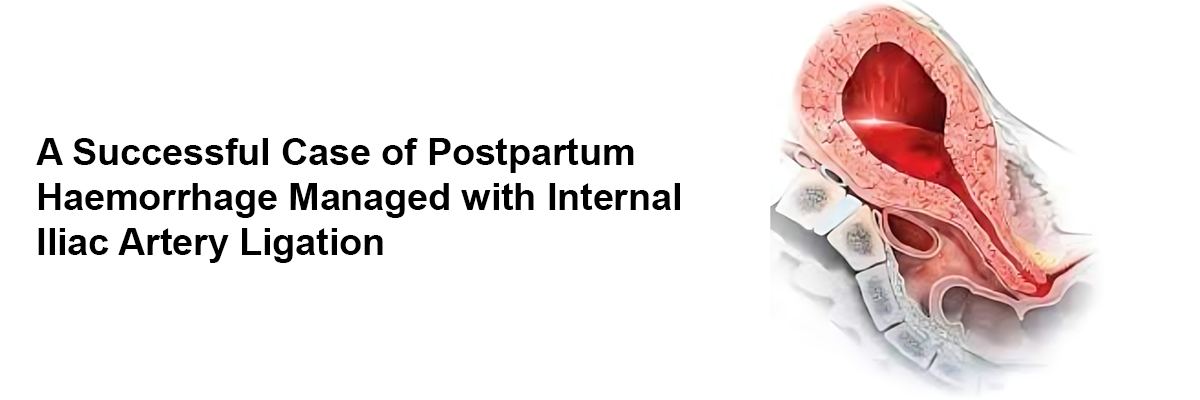

A Successful Case of Postpartum Haemorrhage Managed with Internal Iliac Artery Ligation
A report describes a case of a 35-year-old primigravid who presented at 38 weeks of gestation with gestational hypertension, thrombocytopenia, and large subserosal fibroid in the lower uterine segment. Her ultrasound (USG) report showed a single live intrauterine pregnancy accompanied by a subserosal fibroid (10×9×5.4 cm) in the lower uterine segment.
The patient was prescribed labetalol 100 mg orally TID to control the hypertension. She was incidentally diagnosed with gestational thrombocytopenia (platelet counts 52000/mm3).
The patient experienced spontaneous labor. However, intrapartum monitoring was non-reassuring, with poor beat-to-beat variability. Artificial membrane rupture showed thick meconium-stained amniotic fluid. Thus, an emergency cesarean section was planned.
Surgery revealed a single large subserosal vascular fibroid (10×9×5) populating most of the lower uterine segment. A lower uterine segment was chosen for incision, sparing fibroid edges, and a healthy Female child was delivered. The fibroid caused an atonic lower segment of the uterus with difficulty in wound closure. Hence, a cesarean myomectomy with ligation of a large feeding artery was performed. Injection oxytocin 10 IU, injection carboprost 250 microgram, and tablet misoprostol 800 mg were administered along with an injection of tranexamic acid 1 gram repeated twice. Since the blood loss was not totally arrested, bilateral internal iliac artery ligation was performed. The patient recovered uneventfully and received a discharge on the seventh day after the index procedure with a normal involuting uterus.
On further follow-up to six months, repeat USG showed no fibroid, and the patient remained asymptomatic.
Source: Obstetrics and Gynecology. 2023;13(3)


Recent FAQs




Related FAQs






Medtalks is India's fastest growing Healthcare Learning and Patient Education Platform designed and developed to help doctors and other medical professionals to cater educational and training needs and to discover, discuss and learn the latest and best practices across 100+ medical specialties. Also find India Healthcare Latest Health News & Updates on the India Healthcare at Medtalks







Please login to comment on this article